Paper instructions could not keep pace with the line.
Production lines relied heavily on printed instructions and manual verification, leading to inconsistencies and delays. Operators had developed informal methods over time, creating variations in assembly accuracy and documentation.
- Inconsistent operator methods
- Paper-based verification added friction
- Outdated hard-copy instructions
- Limited checkpoints for accountability
How might digital line tracing and visual guidance reduce production errors while improving efficiency?
Design from the production floor out.
Research began on the production floor: shadowing operators, conducting informal interviews, and testing prototypes directly with the people assembling laboratory automation systems.

William
Manufacturing Engineer
In his second year at the company, William supports multiple production lines. Updated work instructions are the last thing on his mind while he puts out fires on the floor.
Minimize production errors.
- Separate instruction documents are difficult to maintain
- Production and operator accountability are hard to track
- Assembly errors lower output per line

Frank
Inexperienced Operator
New to the production floor, Frank has basic tool-handling experience and needs to move slowly through unfamiliar, customer-specific builds.
Learn the assembly process with minimal confusion and errors.
- Language barriers
- Unfamiliar assembly processes
- Flipping through instructions takes too long

Kim
Experienced Operator
Kim has years of experience across multiple lines and products. She uses batch-style assembly and rarely opens the dense work instructions.
Work quickly and error-free while understanding the current build.
- Too much production paperwork
- Needs to move quickly through assembly
- Dense and unreliable work instructions
Research & discovery
Direct observation exposed how operators adapted instructions, tools, and verification steps under real production pressure.
Design & iteration
Early iterations focused on digitizing the most error-prone steps and streamlining verification. The Visual Factory platform integrated digital instructions, embedded CAD visuals, and real-time checkpoints to improve traceability.
Remote collaboration
When COVID-19 limited direct user access, observational data and iterative reviews with the Manufacturing Engineering Manager guided refinements to usability and flow.
Interactive instructions made the assembly process visible.
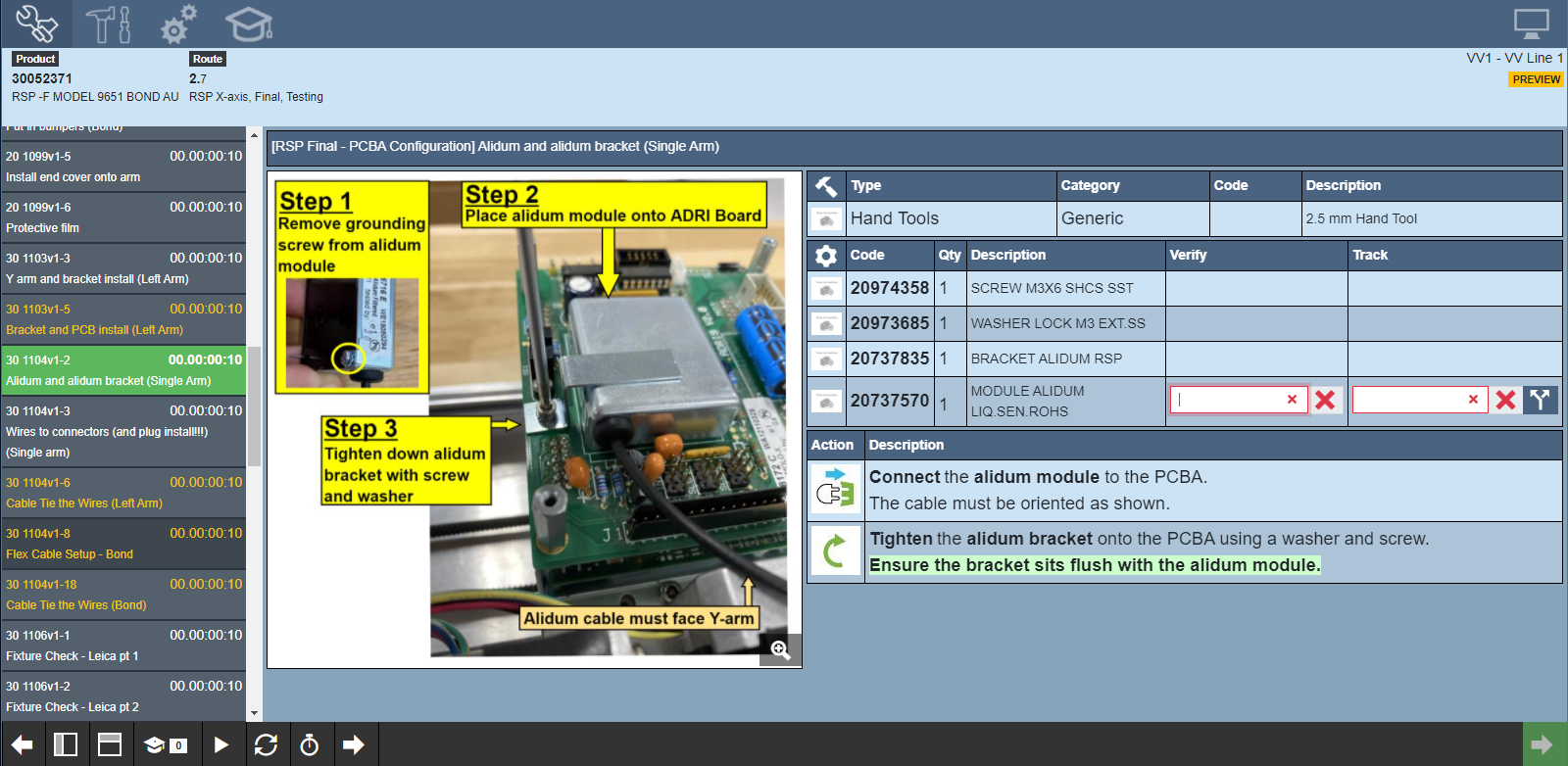
The redesigned Visual Factory replaced static documents with interactive digital instructions that provided visual cues, progress tracking, and clearer accountability.
- Modular instruction flow by assembly step
- Embedded CAD visuals for context
- Built-in verification checkpoints to reduce batching errors
Proximity, adaptability, and visual clarity.
The work at Tecan bridged user research and manufacturing design in a technical, high-stakes production environment.
The project reinforced the importance of proximity to users, adaptability when access is limited, and visual clarity when instructions shape physical work.
Supporting a company that equipped medical labs during COVID-19 underscored how thoughtful systems design can create tangible impact.